
Integration Descriptions
Integration Descriptions
Adding a description to a feedback integration gives Enterpret's prediction models more context about the data being ingested. Better descriptions lead to more accurate theme and reason predictions.
A well-written description covers three things:
What feedback is being sent — e.g., support tickets, app store reviews, sales call transcripts, customer interviews
Who wrote it — e.g., paying customers, trial users, enterprise accounts, prospects
What you're trying to learn from it — e.g., identifying product pain points, tracking feature adoption, understanding churn drivers
Which integrations require a description
For the following sources, a description is required when creating a new integration:
File Upload, Salesforce, Snowflake, Webhook, Email, Typeform, Survey Monkey, Slack, Discord, Discourse, StellaConnect, Delighted, G2, Facebook Pages, Reddit
For all other integrations, a description is optional but recommended. If you notice that Reasons or Theme predictions for a particular integration are inaccurate, improving the description is a fast first step.
Adding or editing a description
Open the Integrations page from the left navigation bar.
Click on the integration you want to update.
Locate the description field and click to edit.
Enter or update the description. Keep it concise but informative, covering the three key questions above.
Click Save.
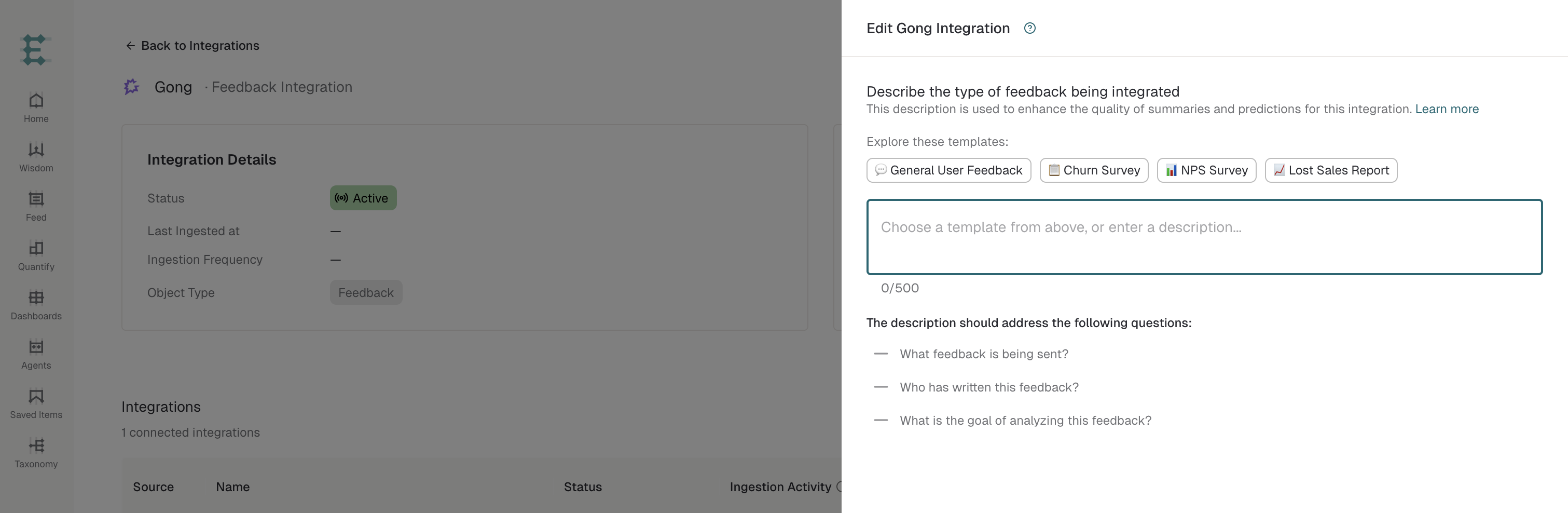
Descriptions can be added or updated at any time. Changes apply to future analysis and do not retroactively update existing predictions.
Impact on existing integrations
Adding a description to an existing integration does not change or break any existing setup. The description is used as additional context from the point it is added.
Available integrations
Feedback source integrations
Gong — Ingest call recordings and transcripts from Gong. Automatically tag calls by product area, win/loss status, and customer segment. Analyze sales and support conversations at scale. As of February 2026, quotes are attributed to specific speakers with timestamps.
Slack — Pull messages and conversations from Slack channels. Use for community feedback, internal discussions, or customer support channels.
Discord — Ingest messages and conversations from Discord servers. Common for gaming, open-source, and developer communities.
Email — Upload or forward customer emails directly to Enterpret. Tag support emails, customer feedback messages, or inquiry threads.
Salesforce — Sync Salesforce records including Cases (support tickets), Opportunity notes, and Contact feedback fields.
Salesforce Service Cloud — Sync service cases, live chat transcripts, and email messages. Analyze support tickets and customer interactions at scale. Integrates with Cases, Live Chat, Email, and Knowledge articles.
File Upload — Manually upload CSV, Excel, or text files containing customer feedback, survey responses, or feedback data from custom systems.
Typeform — Connect Typeform surveys and forms. Automatically ingest survey responses for product research, NPS, or CSAT feedback.
Survey Monkey — Ingest survey responses from SurveyMonkey campaigns and questionnaires.
Delighted — Sync NPS surveys, CSAT feedback, and customer satisfaction data from Delighted.
G2 — Ingest reviews and feedback from the G2 review platform. Analyze competitive positioning and customer perception.
Reddit — Pull posts and comments from specified subreddits. Monitor community discussions, feature requests, and complaints.
Facebook Pages — Ingest comments, messages, and posts from your Facebook Pages. Analyze public feedback and customer inquiries.
Instagram — Pull comments and messages from your Instagram business profile. Capture social media feedback and sentiment.
Trustpilot — Sync reviews and ratings from Trustpilot. Analyze review content and customer sentiment at scale.
Zoom — Ingest Zoom meeting recordings and transcripts. Analyze customer calls, interviews, and support sessions.
Discourse — Pull posts and threads from Discourse community forums. Monitor feature requests, bug reports, and user discussions.
Webhook — Send customer feedback from your custom applications, tools, or systems via API. Requires a description specifying the source and type of feedback.
Linear — Sync customer feedback and insights to Linear issues. Create or update Linear issues based on Enterpret findings and customer feedback themes.
JIRA — Sync Enterpret insights to JIRA tickets and projects. Create or update JIRA issues to track product insights and customer feedback themes.
Example descriptions
For Slack:
"Messages from our internal #customer-feedback channel where sales, support, and CS team members post direct customer quotes, complaints, and feature requests they encounter during customer interactions."
For Salesforce Cases:
"Support tickets from our Salesforce Service Cloud. Created by our support team when customers report bugs, ask for help, or submit feature requests. Includes enterprise and SMB customers."
For Zoom:
"Sales and support call recordings. Sales team records customer discovery calls with prospects and customers. Support team records customer troubleshooting calls. We want to understand objections, pain points, and unmet needs."
For File Upload:
"Quarterly NPS survey responses collected via email. Respondents are a mix of active users, lapsed users, and churned customers. Used to understand satisfaction drivers and churn reasons."
For Instagram:
"Comments on our company Instagram posts. Includes both direct feedback and sentiment from our social media audience. Used to monitor brand perception and surface emerging issues in public conversations."
For Trustpilot:
"Customer reviews and ratings from Trustpilot. Used to understand perception relative to competitors and identify product gaps that prospects see."
For JIRA:
"Customer feedback themes that we're creating JIRA issues to track. These are aggregated customer pain points and feature requests that the product team has prioritized for investigation or implementation."
Best practices for descriptions
Be specific: "Customer feedback" is too vague. "Support tickets from our Help Scout account, submitted by SMB customers experiencing issues" is more useful.
Update when things change: If you modify which channels you're pulling from Slack, or which customer segments you're tracking, update the description.
Use for troubleshooting: If theme predictions seem off, check your description first. Often a more detailed description improves accuracy significantly.